
By Felicia Guo
In the rapidly evolving world of digital products, few designers have made as deep and lasting an impact on large-scale systems as Jiani Lin. From the beginning of her career, she approached design not only as an aesthetic practice but as an architectural discipline—one rooted in logic, structure, and long-term coherence. Where many designers concentrate on individual screens or visual polish, Jiani has always been drawn to the invisible frameworks beneath: the rules that govern ecosystems, the patterns that enable consistency, and the governance models that make digital platforms sustainable as they grow.
Her early years in consulting proved to be a defining period. Working with global enterprises—spanning technology, travel, manufacturing, and finance—meant stepping into environments marked by complexity and constant change. These platforms crossed markets, languages, business units, and years of legacy decisions. Ambiguity was the starting point, but Lin quickly emerged as the person who could bring clarity, unite cross-functional teams, and turn sprawling digital landscapes into coherent systems. Her role naturally evolved toward design system leadership, where her strategic thinking could scale across entire organizations.
Across these engagements, Lin led large-scale transformation programs that delivered clear, measurable business results. By introducing modular, SEO-friendly content structures, she helped organizations dramatically improve engagement and discoverability—driving a 94% increase in search starts, a 76% lift in SEO rankings, and brand-level performance gains including 10-percentage-point increases in engagement, 39% year-over-year sales growth, and 34% improvements in search ranking. Through unified component libraries and coherent design logic, she streamlined product exploration for millions of users and directly influenced higher conversion behavior across complex digital ecosystems.
Beyond experience design, Lin’s leadership extended to operational excellence. Her governance models reduced design and front-end development costs, accelerated time-to-market, and ensured long-term alignment across global teams. Industry research further validates this impact: mature design systems have been shown to reduce design and development costs by 35–50% and enable teams to complete design tasks approximately 34% faster—efficiency gains that Lin helped organizations realize at scale. These outcomes enabled companies to move faster, build more consistently, and sustain growth while serving millions of users worldwide.
These contributions did not go unnoticed. Lin’s work earned recognition from the Indigo Design Awards (Gold & Silver), the W3 Awards (Silver), and the Shorty Awards (Bronze & Finalist), underscoring not only creative excellence, but the tangible business value of her strategic leadership.
From these large-scale programs, Lin developed a clear belief that design systems are not stylistic assets—they are strategic infrastructure. She often emphasizes that consistency across a global ecosystem does not happen by accident. It must be intentional, shaped by leaders who define shared rules, communicate rationale, and make decision-making transparent. Equally important is sustainability: without governance and stewardship, digital products drift, degrade, and fragment. With the right systems in place, teams gain clarity and confidence, freeing them to innovate rather than constantly reinvent.
A defining dimension of her leadership is her commitment to accessibility at scale. The numbers remain stark: more than a quarter of U.S. adults live with a disability, yet the vast majority of websites continue to fail basic accessibility checks. To Lin, accessibility cannot be fixed piecemeal—it must be embedded structurally. In the systems she leads, accessibility is woven into every level: contrast-aware tokens, semantic and keyboard-accessible components, WCAG-compliant templates, and clear, actionable documentation. Through governance models that require accessibility by default, she enables organizations to deliver inclusive experiences across markets and products, turning accessibility from an afterthought into an institutional standard.
Her work across industries reinforced interconnected lessons. She learned that unifying large organizations requires more than standardization; it demands shared logic and frameworks that teams can trust. Systems must support creativity, not restrict it, allowing brands to maintain individuality while benefiting from shared foundations. Aligning long-standing identities requires nuance, respect, and an understanding that structure should empower—not overshadow—storytelling and user needs. Ultimately, she saw that systems are powerful tools for making complexity legible, helping users navigate dense information with confidence.
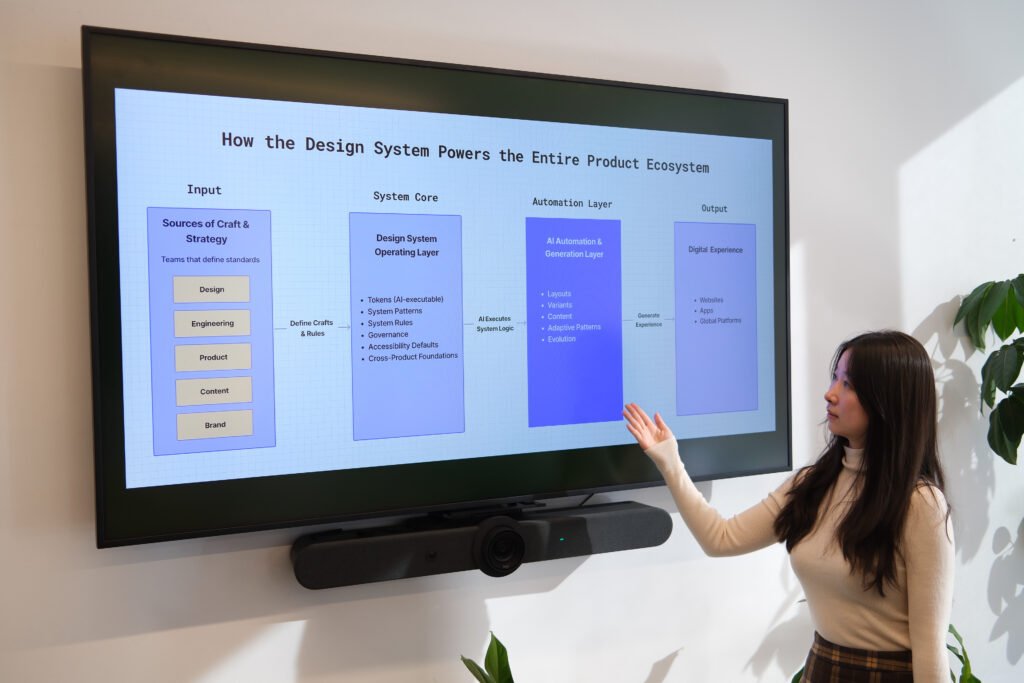
Lin is at the forefront of defining how AI will build digital products. She is architecting semantic design systems—AI-executable design tokens, interoperable patterns, and standardized component logic—that allow AI tools to interpret intent and automatically generate consistent, accessible, on-brand interfaces at scale. Rather than waiting for the industry to evolve, she is actively building the infrastructure that will guide AI-driven creation, positioning design systems as the backbone of future enterprise platforms.
At the core of her philosophy is a simple conviction: sustainable digital futures require sustainable systems. And it is leaders like Jiani Lin—strategic, thoughtful, and deeply committed to clarity—who are building the foundations that will carry digital products into the next generation.